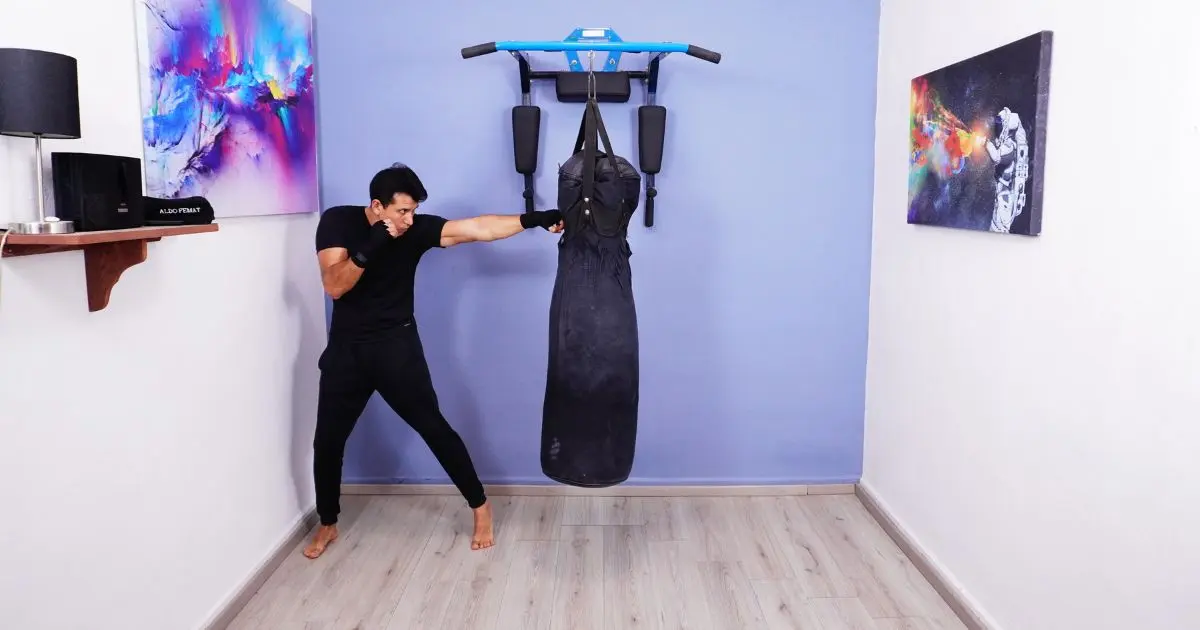
If you're just starting out with boxing, the first thing you need to learn is how to hit — and hit correctly. Boxing punches are the foundation of every combination, every workout, and every defensive move. Before you can put together a real routine, you need to understand what each punch is, what it's called, and how to throw it. This guide covers exactly that, and it fits perfectly into your home workout (LINK) routine. For more context on training without a gym, check out our Boxing and Muay Thai at home (LINK) overview.
The 4 Basic Boxing Punches and Their Names
There are four fundamental boxing punches names every beginner must know. Everything else in boxing — combinations, counters, footwork — builds on these four.
1. Jab
The jab is your fastest punch. It comes from your lead hand (left hand if you're orthodox, right if you're southpaw). It's not your power punch — it's your setup tool.
How to throw it: Extend your lead hand straight out, rotate your fist so the palm faces down at full extension, and snap it back immediately. Keep your rear hand up to protect your chin.
2. Cross
The cross is your power punch. It comes from your rear hand and travels in a straight line. Your hips and back foot rotate into it — that's where the power comes from, not just your arm.
How to throw it: Push off your rear foot, rotate your hips forward, extend your rear hand straight, and return to guard quickly.
3. Hook
The hook is a curved punch that targets the side of the head or body. It can come from either hand and is one of the most powerful types of boxing punches when thrown correctly.
How to throw it: Bend your elbow to about 90 degrees, rotate your hips and shoulder together, and swing your fist in an arc. Keep the movement tight — a wide hook is easy to see coming.
4. Uppercut
The uppercut travels vertically and targets the chin or body from below. It's effective at close range and catches opponents off guard when used after jabs or hooks.
How to throw it: Drop your shoulder slightly, drive upward with your legs and hips, and bring your fist up in a short, tight arc. Don't wind up or you'll telegraph it.
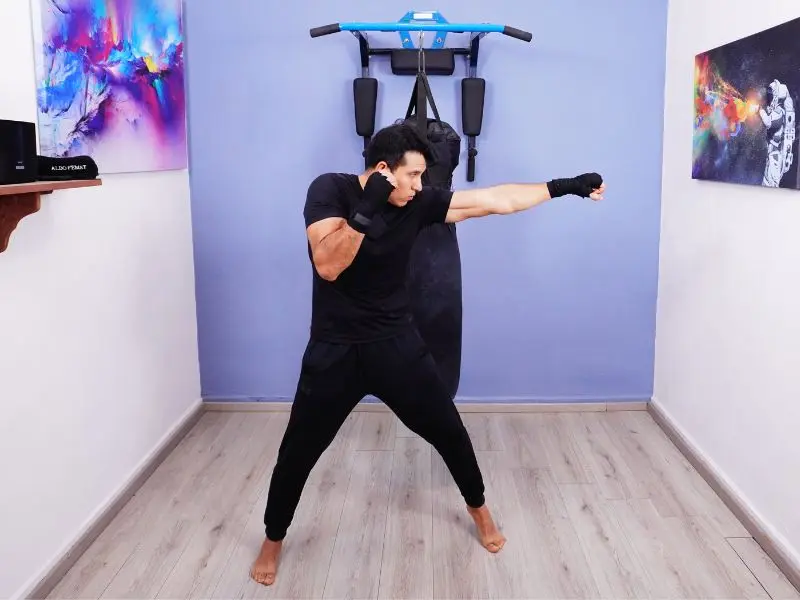
How to Practice Boxing Punches at Home
You don't need a gym to start building your punching technique. Here's a simple structure for beginners:
Shadow boxing — Throw each punch slowly in front of a mirror. Focus on form, not speed. 3 rounds of 2 minutes is enough to start.
Bag work — A wall-mounted punching bag lets you feel resistance without taking up floor space. Start with single punches, then move to 2-punch combinations (jab–cross, cross–hook).
Drill repetition — Pick one punch per session and drill it until it feels automatic. Consistency beats variety at the beginner stage.
As you get more comfortable with each of the four strikes, start pairing them. The jab-cross (1-2) is the most common combination in boxing for a reason — it sets up everything else. If you want to see how these punches fit into a full session, this boxing workout at home breaks it down step by step.
Learning boxing punches correctly from the start saves you from bad habits that are hard to break later. Master the jab, cross, hook, and uppercut — in that order — and you'll have a real technical foundation to build on. Keep your sessions focused, your form clean, and your repetitions consistent.
Ready to add real resistance to your training? The TBX Galactic Boxing Bag Wall Mount is built for home training — compact, durable, and ideal for practicing all four punches without needing a full gym setup.