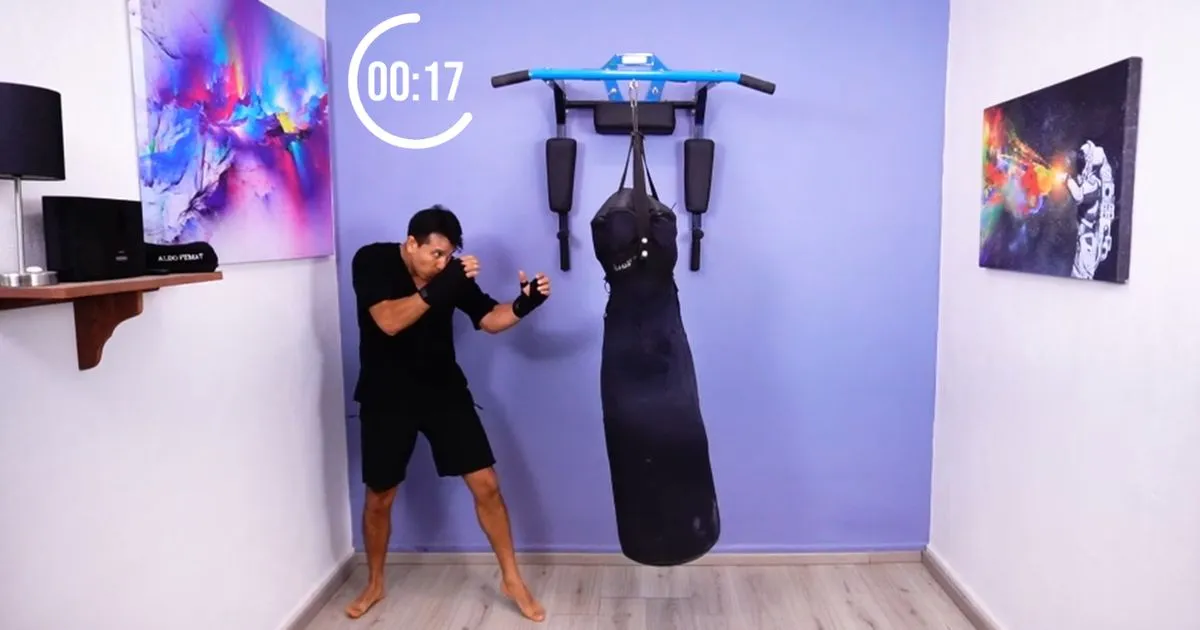
You don't need a gym membership or a full ring to start boxing. A boxing workout at home gives you a real cardiovascular challenge, builds coordination, and teaches you foundational technique — all from your living room. Whether you're new to combat sports or just exploring your options for home workout (LINK), this guide walks you through exactly how to get started.
What You Need Before Your First Boxing Workout at Home
Before you throw a single punch, get these basics in place:
Space. Clear at least 6×6 feet of open floor. You need room to move your feet, not just your arms.
Footwear. Wear flat, non-slip shoes or train barefoot on a mat. Avoid running shoes — the thick sole throws off your balance.
Wraps or gloves. For pure shadow boxing, you don't need either. If you plan to hit a bag, hand wraps protect your wrists. A wall-mounted bag like the TBX Galactic Boxing Bag Wall Mount is a practical option for beginners who want to start hitting without taking up floor space.
A timer. Boxing is round-based. Use 3-minute rounds with 60-second rest periods. Any free timer app works.
That's it. You're ready to start.
Step-by-Step: Your First Boxing Workout at Home
Follow this structure for your first session. Each step builds on the previous one.
Step 1 — Find Your Stance
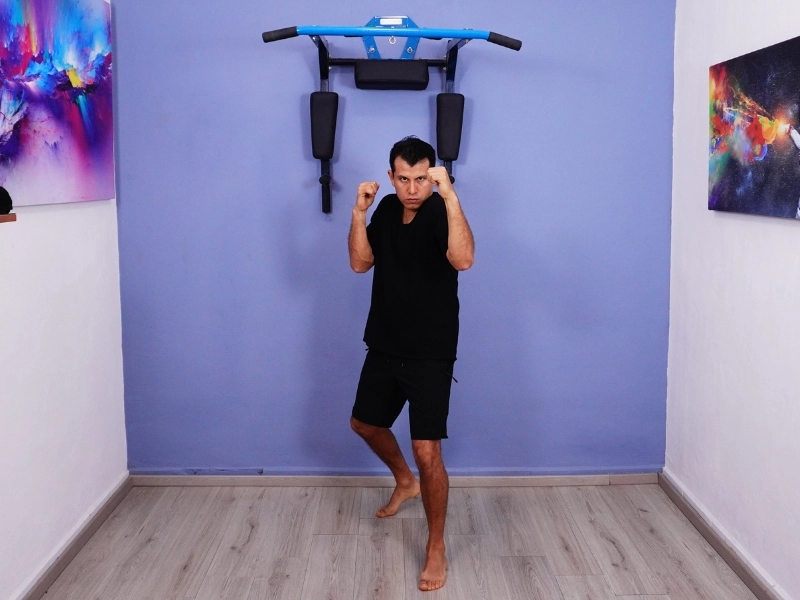
Stand with your feet shoulder-width apart. If you're right-handed, step your left foot forward. Your left shoulder faces your target. Bend your knees slightly, keep your weight centered. Raise both fists to chin height. This is your guard — it's where every punch starts and ends.
Step 2 — Learn the Two Basic Punches
Before drilling combinations, understand the jab and the cross. These are the foundation of nearly every boxing combo. Get familiar with the basics of boxing punches (LINK) before moving on to hooks or uppercuts.
Jab: A quick, straight punch with your lead hand (left hand if you're orthodox). Extend and retract fast. It's not about power — it's about speed and distance control.
Cross: A straight punch with your rear hand (right hand), driven by hip rotation. This is your power punch.
Practice each punch 20 times, slowly. Focus on form, not speed.
Step 3 — Shadow Box for 3 Rounds
Now put it together. Shadow boxing means you're boxing an imaginary opponent. Move your feet, throw jabs and crosses, return to your guard after every punch.
Round structure:
Round 1: Jab only, focus on stance
Round 2: Jab + cross combos
Round 3: Move freely, throw punches at your own pace
Rest 30 seconds between rounds.
How to Progress After Your First Session
A single session won't make you a boxer — but consistency will.
Add rounds gradually. Start with 3 rounds per session. After two weeks, go to 5. After a month, aim for 6–8.
Introduce new punches one at a time. Hook and uppercut come after your jab-cross is clean and automatic.
Consider a bag. Shadow boxing builds form and cardio, but hitting a bag adds resistance and timing. A wall-mounted option like the TBX Galactic Boxing Bag Wall Mount fits small spaces and doesn't require ceiling hooks or a stand.
Track your rounds. Write down how many rounds you did and how you felt. Progress is hard to see day to day, but easy to see week to week.
Starting a boxing workout at home is straightforward when you focus on the fundamentals. Stance, two punches, and three rounds is a complete beginner session. Keep it simple, keep it consistent, and the technique will follow.